
Unlike other parts of the year when Fairhope's council chamber draws smaller crowds, the sunny afternoon of Wednesday, April 15, was far different.
Before the trial began, a crowd of around 30 …
This item is available in full to subscribers.
Please log in to continue |

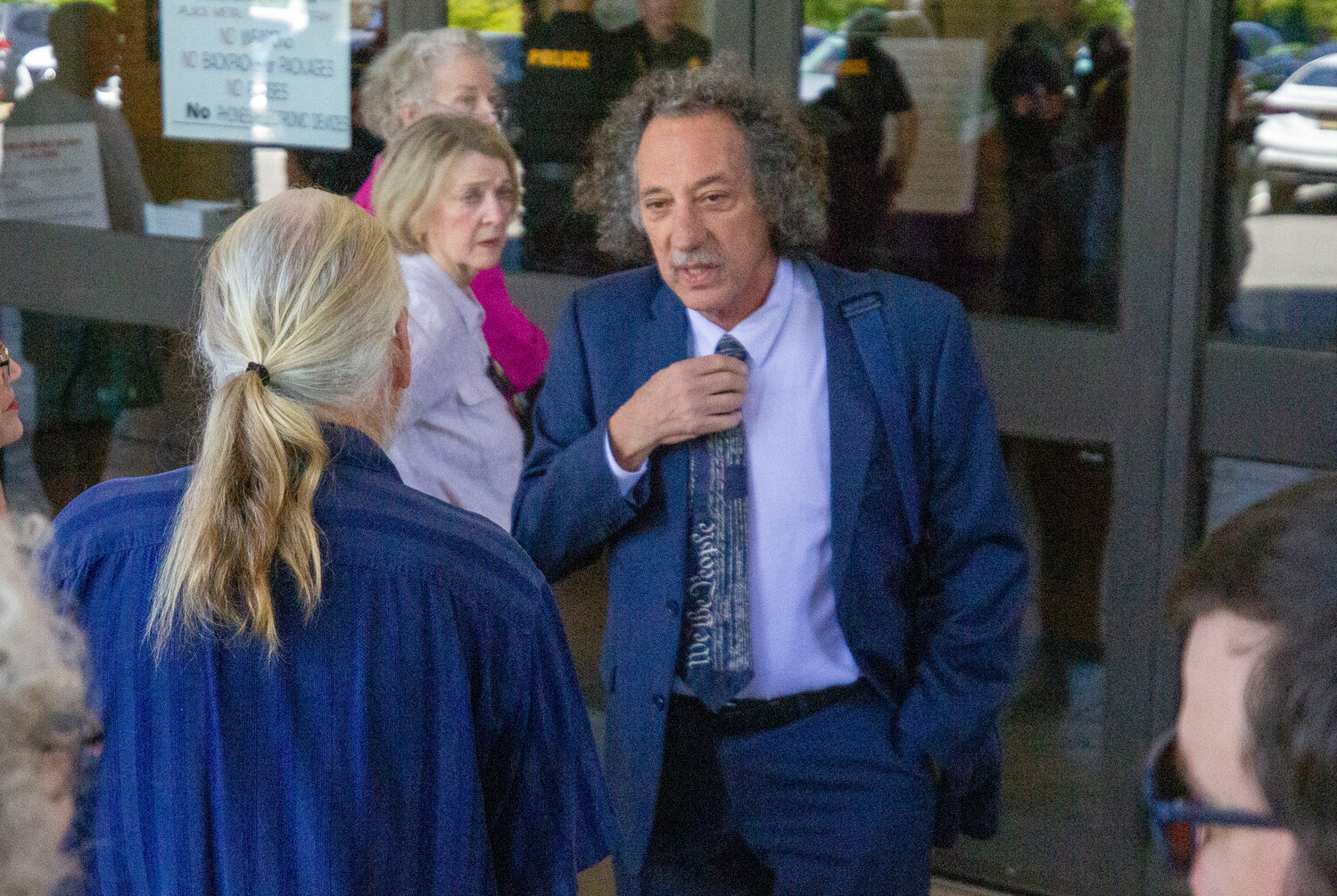


Unlike other parts of the year when Fairhope's council chamber draws smaller crowds, the sunny afternoon of Wednesday, April 15, was far different.
Before the trial began, a crowd of around 30 to 40 people stood outside the doors of the Fairhope Municipal Complex as police officers inside prepared to let people in for the court proceedings. Some came wearing costumes, like an eggplant, while others came bearing signs that could be viewed as humorous and/or confrontational.
“Don’t be a meanie, it’s just a weenie!” one of the signs read.
"People should not be afraid of their governments," another sign read. "Governments should be afraid of their people."
An older man in attendance was seen wearing a “This Machine Kills Fascists" shirt, similar to what folk hero Woody Guthrie christened on his guitars years before.
Finally, the person at the center of the case, Jeana Renea Gamble, arrived, wearing sunglasses and a facemask along with her pink cotton dress and white shoes. Her supporters immediately recognized her, and cheers rang out as she walked through the crowd.
“We got your back, Renea!” one person shouted.
“Free speech for all of us!” she told the crowd as chants of “free speech” began.
Gamble was heading into the municipal complex for her long delayed and long awaited trial centered on her arrest that took place at a “No Kings” protest in Fairhope last year.
On Oct 18, 2025, Gamble, 62, was on the corner of Greeno Road and Fairhope Avenue with other protesters as part of nationally held events against the policies and actions of President Donald Trump and his administration. During the protest, Gamble was seen wearing a giant phallic-shaped costume while holding a sign that read “No Dick-Tator.”
Gamble was confronted by Fairhope police, including police Col. Andrew Babb, about her costume. Body cam footage of their encounter was released in November. In it, Babb told her that her costume isn't acceptable “in a town with values.”
“I’m not going to sit here and argue with you,” Babb can be heard saying in the video. “If my kids came by here to see this, how would I explain this?”
“Are you recording?” Gamble asks.
“How would you explain to my children what you are supposed to be?” Babb replies. “This is a family town. I’m not going to have someone out here dressed like this. It’s abusive."
Gamble was asked to identify herself, to which she responded by saying, “I’m Aunt Tifa,” a wordplay referencing the left-wing anti-authoritarian political movement antifa.
In the footage, Gamble can be heard asking at least three times if she is being detained. With no answer from the police, she begins to walk away when Babb reaches for the back of her costume and pulls her backward to the ground before, along with two other police officers, wrestling to put handcuffs on her as she is then taken to a police vehicle.
Following her arrest, Gamble received misdemeanor charges for disorderly conduct and resisting arrest and later received additional charges related to giving officers a false name and violating a city ordinance related to disturbing the peace. The false name charge was dropped, with Gamble pleading not guilty to all other charges.
THE TRIAL
In a trial that lasted roughly three hours, both sides argued their case before Municipal Judge Haymes Snedeker.
Fairhope City Attorney Marcus McDowell argued that Gamble was a distraction and safety risk to drivers on the road and insisted her arrest had nothing to do with her political views, saying police did not violate her First Amendment rights to free speech at any point during or after her arrest.
David Gespass, Gamble’s lawyer, argued that Gamble was never a risk to drivers and no one had an issue with her costume until police arrived, arguing Babb used his own beliefs to arrest Gamble as she was never told about safety concerns during her arrest.
Babb gave extensive testimony as the first witness to be called. He said he was called to respond to multiple complaints of obstruction of traffic, such as people in the road, as well as reports of counter-protesters throwing water bottles at people participating in the No Kings rally. He described the situation as a “brush fire” that they didn’t want to turn into a “dumpster fire.”
Babb said that it was when he pulled into a parking lot close to where the protest was taking place that he first observed a “7-foot tall inflatable penis,” adding he was not paying attention to the sign she was holding. Thinking it was a teenager, he said he asked them to remove the costume or they needed to leave, to which he said there was silence.
Babb said he asked her to remove the costume for safety concerns, saying the costume gave her low visibility and was distracting to drivers, noting how busy Greeno Road can be during peak traffic hours.
Babb said Gamble made no attempt to comply and tried to pull away when he tried to pull her back. He said he did not know it was “an old woman” until she was on the ground, when other people participating in the protest pointed it out. He also said she never corrected her name until she arrived at the local jail.
Babb said his goal was to ensure the safety of everyone involved and to de-escalate the situation, saying he never said anything about her “sign or politics” and that she would have let her stay had she removed the costume.
McDowell argued that Babb was acting within his duty, saying his comments asking Gamble about if his kids saw her during the incident was his attempt to de-escalate the situation, which is part of common procedure for police officers.
When Gespass asked why Gamble was “picked on,” Babb said if he, as a “reasonable person,” tried to pull out of the parking lot, she would have been blocking his view.
Gespass particularly questioned Babb on how he knew for certain that Gamble was not complying, with Gespass saying she was never told that she was under arrest until after she was pulled to the ground.
When Babb was asked when Gamble was considered to be resisting arrest, Babb said it was the moment when she failed to comply to put her hands behind her back. Despite her limited movement the costume created, Babb said her arms had freedom of movement.
Following Babb’s testimony, Larry Fletcher, Gamble’s husband, testified. He was with Gamble the day of the protest to escort her around due to the costume’s limits, with Fletcher saying she “couldn’t see well” and she had “limited movement.” He was also the one who paid for her bail and picked her up from jail. He said he was not involved in buying the costume, adding it was purchased a “day or two before.” Court filings state the costume was purchased at a Spirit Halloween in Foley.
McDowell questioned Fletcher on if he previously gathered funds for a potential bond in anticipation of Gamble being arrested. Fletcher said, “Of course,” adding they always make sure they have bond money as he gestured toward the police officers in the room, resulting in a burst of laughter from spectators.
Gespass called up several people who were in attendance for the protest as witnesses. Many of them testified that the protest was largely peaceful and they weren’t aware of any issues caused by Gamble, but when McDowell questioned if they heard the conversation between Gamble and Babb that led to her arrest, many said they didn’t despite some witnessing her arrest.
After hours of testimony and arguments, Snedeker said he did not believe that Gamble's free speech rights were violated and that there may have been enough probable cause for Babb to arrest Gamble. However, he also said the city did not have the necessary amount of evidence required for him to convict Gamble, saying he wasn’t “certain beyond a reasonable doubt” to convict her, ruling her not guilty of all charges.
After Snedeker gave his verdict and adjourned the court, a round of applause from Gamble’s supporters erupted in the room. Gamble ecstatically waltzed out the doors of the municipal complex into a group of reporters with microphones recording and cameras in hand, proclaiming, “We have civil rights in Fairhope!”
“We have some growing and relearning to do about the rights the citizens in this town have that happen to be on par with the rest of the nation, and as Alabamians, we dare defend our rights,” Gamble said. “This fight is not over.”
Gamble then walked away without giving any further comment.
Gespass told reporters the verdict was “the only reasonable conclusion that a judge could have drawn.”
“Whether or not there was probable cause, as the judge claimed there was, that’s another question for another time,” Gespass said. “I disagree with that as well.”
When asked about the possibility of a countersuit or further legal action against the city, Gespass indicated it was likely but they “have to make that decision.”
Gespass was asked if he’d advise his client to ever wear a phallic costume again.
“I do not advise my clients as to how they choose to exercise their First Amendment rights,” he replied. “That’s up to them entirely, and I would certainly be honored, if I live long enough, to represent somebody else in the same circumstance.”


