
Mr. Jack Thomas was in his eighth decade when he told me the story of his older brother who raised the first flag on Mount Suribachi in Iwo Jima. The story was brought on by the dedication a new park …
This item is available in full to subscribers.
Please log in to continue |
Mr. Jack Thomas was in his eighth decade when he told me the story of his older brother who raised the first flag on Mount Suribachi in Iwo Jima. The story was brought on by the dedication a new park in Spanish Fort named for Ernest Ivy "Boots" Thomas. Jack was delighted to tell us the real story of the famous flag raising but choked up as he remembered the bravery of not only his brother, but every other service man and woman who fought for our freedom.
Jack said he was probably fourteen years old when he said goodbye to Boots as he headed off to boot camp from their home in Monticello, Florida. Boots had been in college in Indiana when he decided to join up and Jack chuckled a bit when he told of his brother's enlistment in Orlando. Being colorblind, he failed the test the first two times but the third one was the charm. He memorized the pattern when the man next to him responded and he passed with flying 'colors.' He was assigned Pacific front duty immediately in the Volcano and Ryukyu Islands campaign before being sent to Iwo Jima.

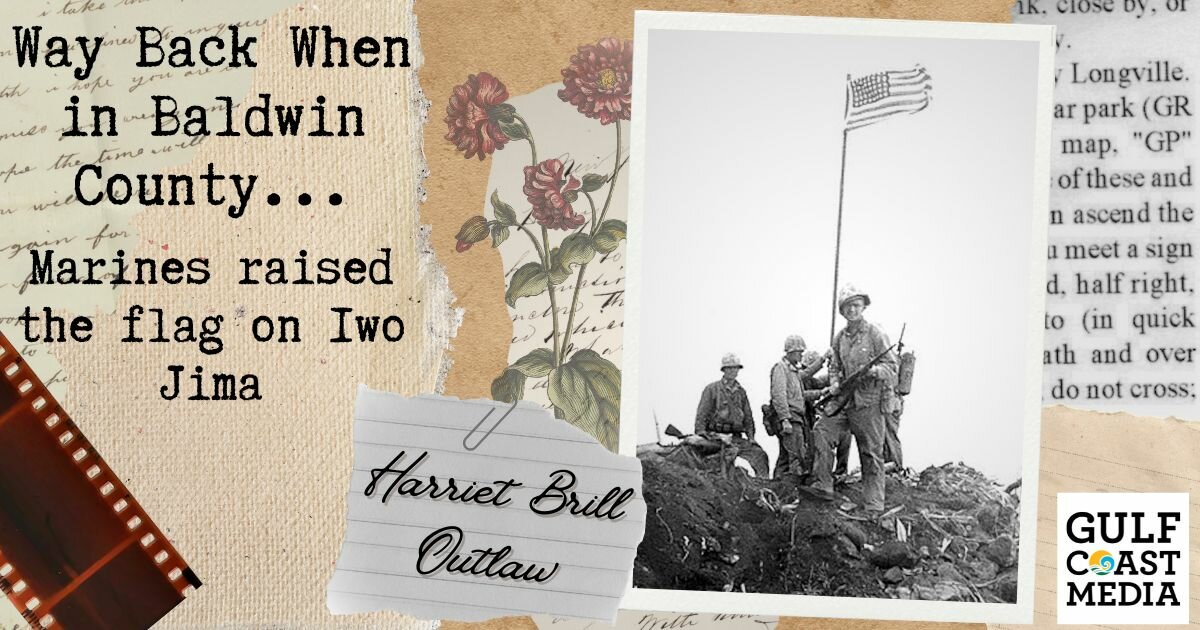
Every American is familiar with the famous photograph of the flag raising on Iwo Jima, but few know that it was actually the second one. As Platoon Rifle Sergeant of the 2nd Battalion, 28th Marines, 5th Marine Division, Sgt. E.I. Thomas led the capture of the summit of Mount Suribachi on Feb. 23, 1945. Immediately the Marines attached a flag to metal pole and lifted it high. It was photographed by SSgt. Louis R. Lowery, USMC. Thomas is holding the rifle in the foreground. The unit remained under attack as they approached the summit.

The higher-ups thought the flag was too small to be seen by Marines fighting for the critical airstrip on the other side of the mountain and from the ships, so it was replaced the same day by a larger one. AP combat photographer Joe Rosenthal captured the second flag being raised and it became viral after it was printed two days later. Boots was also photographed with the second flag but was not one of the Marines erecting it.

Jack's family did not know the whole story when they saw the photograph in the newspaper. When the bereavement officers approached the house, the fear they harbored materialized. Boots was killed in action only eight days after the capture of Mount Suribachi, seven days before his 21st birthday. As the family heard of his meritorious service, they were even more proud of him. He was posthumously awarded the Navy Cross, the Purple Heart Medal and the Combat Action Ribbon.

Jack is gone now, but the story he told lives on. His grandson Todd Thomas continues the family legacy of patriotism, community service and preservation of family heritage. He serves on the Historic Development Commission in the footsteps of his grandfather. Todd was most helpful in resurrecting my memory of the day Jack told me all about his brother, Ernest Ivy "Boots" Thomas.

With Veterans Day fast approaching, we join in the many tributes to our service men and women living in the country they fought to preserve. Veterans Memorial markers dot the map of Baldwin County and the Boots Thomas Park is one of those memorials worth a visit. It is at the end of Sgt. E. I. Thomas Drive in the I-10 Commerce Center in Spanish Fort. The tribute was established thanks to the efforts of Dr. Barry Booth and the Nichols family, who dedicated the park in memory of the bravery of Sgt Thomas. The bronze plaque keeps his memory alive for as long as bronze lasts, hopefully forever.


