
They arrive before the light fully swells over the Gulf.
After crossing the open water overnight, warblers and thrushes, flickers and sparrows, sometimes too many to count, reach the coast in …
This item is available in full to subscribers.
Please log in to continue |


They arrive before the light fully swells over the Gulf.
After crossing the open water overnight, warblers and thrushes, flickers and sparrows, sometimes too many to count, reach the coast in scattered waves — dropping into coastal shrubs and tree lines as they make landfall after a journey scientists are still working to fully understand.
Outside the bird banding station at Fort Morgan, the air is heavy with salt and humidity as morning light crests the tops of the thick canopy; inside, there is only the soft exchange of instructions and the rustle of wings. Vetted volunteers move quietly through mist nets strung along the dunes. Soft mesh bags hang from the spokes of an old bicycle rim repurposed as a rotary clothesline, each cradling a bird briefly paused in its migration.
Fort Morgan, and the Alabama Gulf Coast more generally, sits at the edge of that movement — a narrow spit of land where weather, water and winged travelers converge. For decades, it has been a place where migration is not an abstract concept, but something gently held.
Now, two Baldwin County birders who grew up in that tradition are leading research that is changing what we know about hummingbirds.
A $295,000 federal grant awarded to Emma Rhodes is the latest milestone in HumTrack, an international collaboration she co-founded in March 2024 alongside Kyle Shepard, director of public relations and outreach for the Banding Coalition of the Americas. Using ultralight BluMorpho transmitters weighing just 0.06 grams, the duo is recording what they believe are the first large-scale, high resolution migration tracks ever obtained for ruby- throated and rufous hummingbirds.
The results are already historic.
A rufous hummingbird tagged in Lillian traveled thousands of miles north before its signal disappeared into the wilderness north of Juneau, Alaska, in just 38 days. A ruby-throated hummingbird tagged in Niceville, Florida, moved through the Great Lakes before going silent in Minnesota. To the team's knowledge, these became the first migration tracks ever recorded for either species.
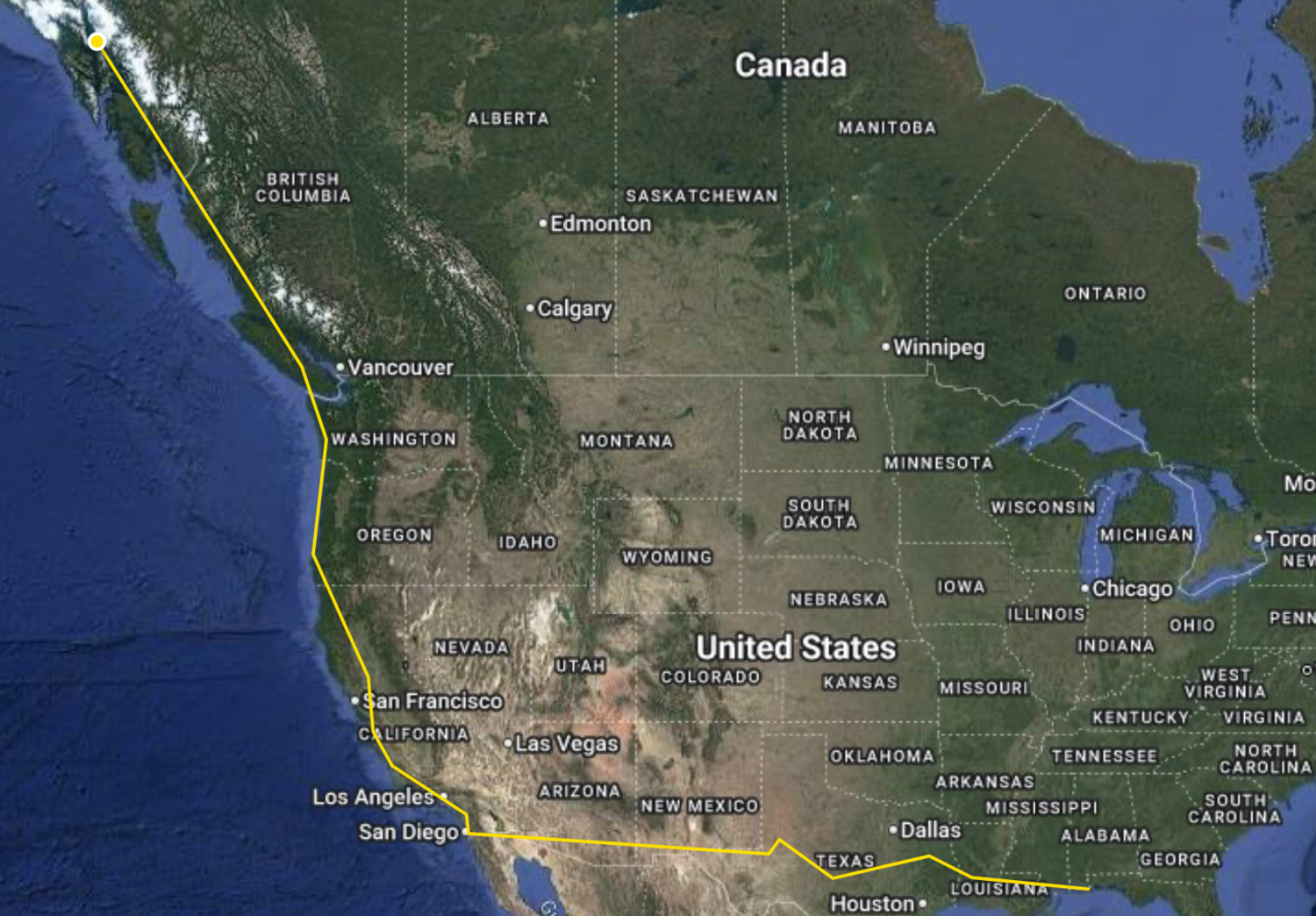 Map showing the route of a rufous hummingbird that Kyle Shepard and Emma Rhodes tagged in Lillian, Alabama that traveled all the way to Alaska.
What began on Alabama's Gulf Coast has grown into a hemispheric effort with a goal to deploy more than 600 transmitters by the end of 2026.
But before the technology, before the grants and before millions of detections began pouring into computer models, there were two kids learning about birds at the tip of Mobile Bay.
Nearly two decades ago, 11-year-old Kyle Shepard came through the Fort Morgan banding station, where Martha Sargent and her husband, “Chief Hummer” Bob Sargent, built the Hummer/Bird Study Group into one of the country's foremost centers for hummingbird and songbird research. By age 12, he had banded his first bird.
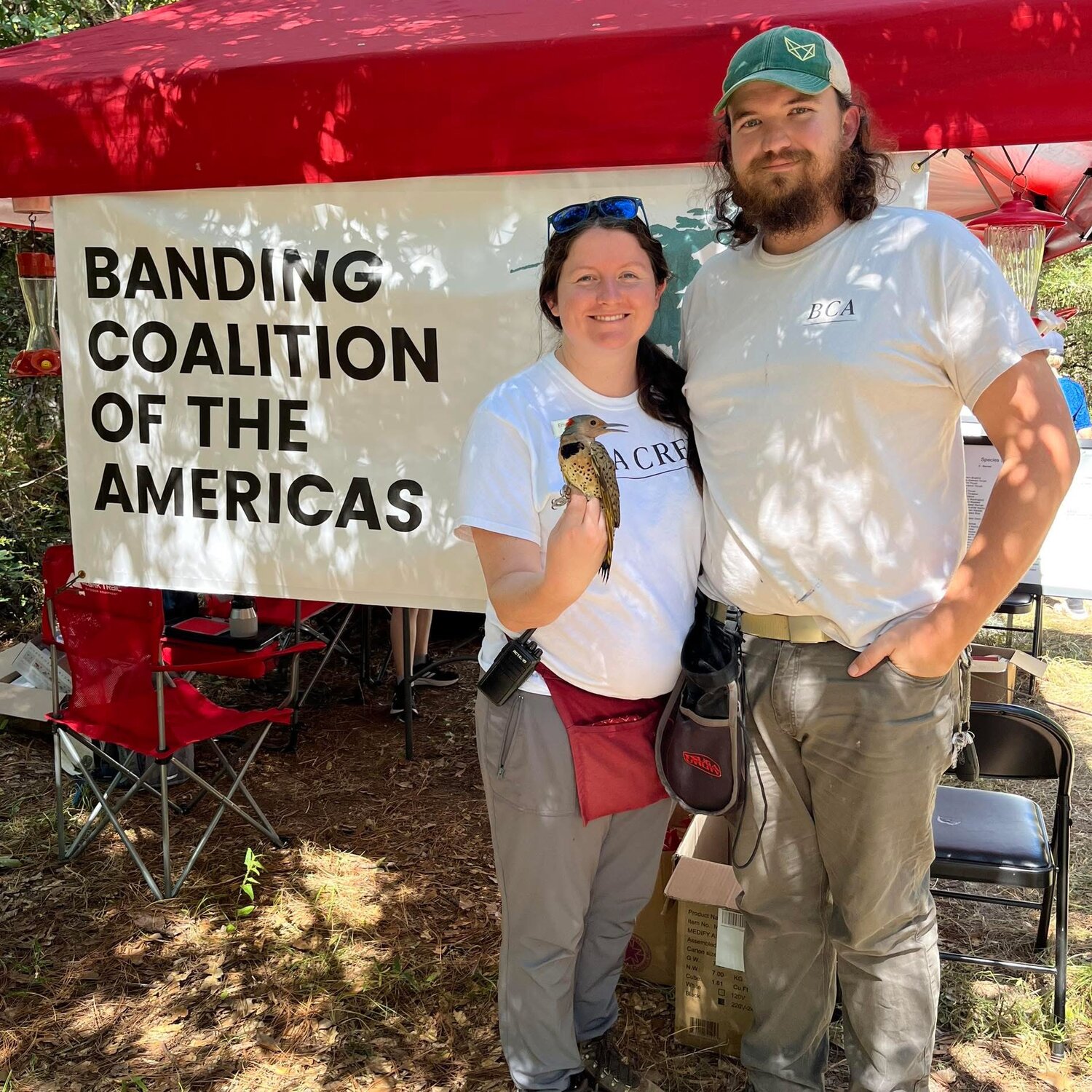 Emma Rhodes and Kyle Shepard, co-founders of HumTrack and the Banding Coalition of the Americas, at a public banding event in Baldwin County.
"It's been a long road," Shepard said.
What began as weekends spent at the banding station eventually became years of field work, logistics and collaboration stretching far beyond Baldwin County. To Mexico. To Idaho.
Emma Rhodes followed a similar path. She began birding when she was 7 and later trained with the Sargents in high school in 2009. Those mornings spent checking nets and recording birds’ weight, wingspan, beak length and fat reserves would become the foundation for an Auburn University doctorate and a career in ornithology.
Today, Rhodes, a researcher with the University of Memphis College of Health Sciences’ Zhang Lab, and Shepard have found themselves carrying the spirit of the Sargents' work forward together through the Banding Coalition of the Americas.
BCA blends decades of banding experience with a growing interest in migration science and conservation. That partnership led to HumTrack and to a technological breakthrough that is beginning to reveal the intricate details of the journeys hummingbirds have followed and passed down for generations.
For most of modern history, hummingbirds have been studied more through observation than scientific certainty. People saw them at feeders and gardens, returning each season with patterns that felt familiar but not completely explainable. What happened between one place and the next was largely inferred rather than proven.
The turning point, Shepard said, came amid ongoing collaborations with engineers and field technologists tied to Cellular Tracking Technologies. A call came in about a new generation of ultralight transmitters being tested on hummingbirds in Mexico.
“I got a phone call… and my brain exploded,” he said.
The devices were Blu-Morpho transmitters — weighing just 0.06 grams, about the weight of a grain of rice and light enough to be attached to birds weighing as little as 2.5 grams, roughly the weight of a penny, without altering their flying ability or habits.
Until recently, tracking of that scale simply did not exist.
 A BlūMorpho tag before being applied to a rufous hummingbird in Daphne, Alabama.
Micah Green
A BlūMorpho tag before being applied to a rufous hummingbird in Daphne, Alabama.
Micah Green
What began as a logistics request — they asked Shepard to send some of his hand-made, often one-of-a-kind banding equipment for a deployment in Mexico — quickly expanded in scope.
“I will give you this stuff for free and buy my plane ticket if I can go,” Shepard said he proposed.
That moment helped formalize what would eventually become Hum-Track: a collaboration between BCA and Cellular Tracking Technologies linking field banders with engineers building the first systems capable of tracking hummingbirds across entire continents.
The first experimental deployments took place in January 2024 in Jalisco, Mexico. From there, the project expanded quickly — not as a single study, but as a growing network of coordinated field sites spanning environments that rarely overlap in a single research program.
Since its inception, HumTrack has trained more than a dozen hummingbird banders and deployed transmitter systems across Idaho, Costa Rica, Colorado, Texas and Louisiana, alongside winter Gulf Coast sites in Mississippi, Alabama and Florida. Fieldwork stretches from coastal marshes to high-elevation valleys, from tropical forest edges in Central America to Alaska’s frozen tundra. Each site contributes a different piece to the same larger system: a map of the full annual cycles of hummingbird movement across the Western Hemisphere.
The technology stack has evolved in parallel. BluMorpho transmitters pair with Blu+ systems that use everyday smart devices, like cell phones, tablets and other Bluetooth-enabled infrastructure, to detect tagged birds in near real time. In high-density cities with hundreds of devices on a single block, the technology can tell you what street the bird is on and, with a bit of calculation, how fast it is traveling.
The connection between Hum-Track and Cellular Tracking Technologies emerged through early experimental collaborations when engineers and field researchers began adapting ultralight telemetry systems originally designed for larger species such as raptors, kangaroo rats, songbirds and marine mammals. As hummingbird-scale constraints forced redesigns, the partnership formalized, merging field banding expertise from BCA with engineering development at Cellular Tracking Technologies to produce a system capable of tracking some of the smallest migratory birds ever studied.
That shift changed the structure of the work itself. Instead of relying on fixed stations alone, the system now draws on distributed detection — effectively turning landscapes with everyday devices we keep in our pockets, on our nightstands and installed in our cars into passive tracking networks.
Across these sites, BCA has funded and deployed 96 BluMorpho transmitters to date, costing approximately $200 each.
 Kyle Shepard speaks to the Banding Coalition of the Americas team at a public bird banding event at Fort Morgan every fall. ..
Micah Green
Kyle Shepard speaks to the Banding Coalition of the Americas team at a public bird banding event at Fort Morgan every fall. ..
Micah Green
“Roughly half of that funding came from South Alabama, people living in Mobile and Baldwin County,” Shepard said.
The expansion has unfolded in waves: winter deployments across the Gulf Coast; 20 tags in Costa Rica in January; 24 additional tags across Mississippi, Alabama and Florida during winter field seasons; and continued breeding-season studies in Idaho and western field sites.
Species coverage has also expanded. Alongside ruby-throated, rufous, black-chinned, broad-tailed and calliope hummingbirds, researchers have now secured authorization for buff-bellied hummingbirds — a Mexican breeder whose migration patterns remain understudied.
One of the most data-intensive sites is in southern Idaho, where open landscapes and high elevation create both challenges and clear scientific conditions.
The site is home to various species of hummingbirds zipping through thin mountain air, their wings flashing reflections of scarlet, violet, emerald and lime green — colors that appear and vanish as the birds whir through sunlight and shadow.
 Kyle Shepard ensures a tracking node is working in Idaho during a research trip for HumTrack. ..
Micah Green
 A node that HumTrack used to ensure the BlūMorpho tech would work.
Micah Green
A node that HumTrack used to ensure the BlūMorpho tech would work.
Micah Green
There, Shepard and Carl Rudeen, a researcher who owns the 1,200-acre study site, deployed 30 receiver nodes, tracking 30 tagged birds during breeding season.
“What we call a node,” Rhodes said, “is just a receiver that we can stick out in the woods or in a field.”
The system recorded more than 3.3 million detections over two months.
But, as Rhodes said, raw detections are not the same as biological movement.
A single bird passing through overlapping detection zones can be recorded repeatedly in seconds. After filtering for usable signals, roughly 70,000 detections remained for modeling habitat use and movement patterns.
The goal is not simply detection, but translation — converting signals into spatial behavior, mapping how individual birds move through breeding landscapes and how they divide space.
In some cases, detection resolution can narrow movement estimates to roughly 50 feet depending on signal strength, a level of precision previously unavailable for birds this small.
For comparison, traditional tracking methods on larger species may yield only a handful of points per day. The HumTrack system can generate thousands.
In Idaho, additional datasets revealed movement patterns across western breeding populations that had never been documented in detail. In Georgia, winter studies on Skidaway Island showed birds returning repeatedly to localized feeding sites, expanding and contracting their range in response to resources.
The question is no longer simply where hummingbirds go, but how they move through changing landscapes.
 Map of routes taken by tagged hummingbirds from the research area in southern Idaho.
HumTrack
Map of routes taken by tagged hummingbirds from the research area in southern Idaho.
HumTrack
Not all tracking happens through receivers.
Along the Gulf Coast, “hummer hosts” have become part of the infrastructure; residents who maintain feeders year-round and often become the first point of contact for banding hummingbirds.
Most hummingbirds appear locally mid-migration, but some call the Gulf Coast home for the winter and nest here. To track them all, researchers sometimes set nets directly in a host’s yard.
For Jasmine Meichner of Fairhope, the experience changed how she understood the birds just outside her window.
“I think it’s a once-in-a-lifetime thing,” she said. “There’s something magical about them.”
She described watching returning hummingbirds across multiple seasons, including several rufous that came back to her yard year after year before being banded and now tracked. She was not just observing birds — she was watching data unfold in real time.
Ellen Crotty of Foley described similar moments of recognition and surprise.
“It was absolutely awesome watching where all he went,” she said, recalling how the bird “would just fly all over,” including stops at the local Dollar General and Goodwill before returning each night.
“The idea that this little bird that spent every night in my backyard and was in my feeder every morning was going two miles down the road just to fly around and see what was what and then would come back every night — that was just awesome to know,” she said. “You always wonder, what do they do all day? Do they just sit in the tree all day? Do they go off somewhere? It was really interesting to be able to see where they were.”
Rhodes’s $295,000 grant now anchors the next phase of HumTrack’s expansion.
The funding will support deployment of 500 BlūMorpho transmitters across seven Southeastern states beginning this fall and winter followed by habitat and abundance modeling, meaning researchers will use the collected tracking data to analyze where the species lives and to estimate its population size across the region. All of BCA’s work is conducted under a federally authorized bird banding permit issued by the U.S. Geological Survey’s Bird Banding Lab.
Rhodes’s work spans avian migration energetics, migratory connectivity research and coastal avian movement ecology. However, she and Shepard are increasingly focused on integrating field biology with spatial analytics at scale.
 Emma Rhodes checks a trap in Daphne, Alabama...
Micah Green
Emma Rhodes checks a trap in Daphne, Alabama...
Micah Green
“It’s going directly to what I love, which is migration science,” she said. “And to studying hummingbirds and doing this novel thing.”
She said the opportunity exists only because years of experimentation came first. “If we had not again started this iterative process, I could not have taken advantage of the opportunity,” Rhodes said. “I’m so ecstatic that we get to do this with this grant.”
The grant builds on a system that is rapidly expanding in both size and resolution.
With the goal of 600 total tag deployments by the end of 2026, HumTrack will be integrating data streams from North America, Central America and the Caribbean into a single migratory framework.
The goal is no longer simply tracking individuals but modeling full annual cycles — wintering grounds in Costa Rica, stopover sites across the Gulf Coast and breeding territories as far north as Alaska.
But the work at each site still remains its own, supported by avian lovers and boots on the ground. Back at Fort Morgan, before dawn breaks, the dunes are still. Mist nets hang undisturbed between shrubs.
Somewhere offshore, new waves of birds are approaching land as another day approaches and the cycle continues.
The Gulf is dark and stable, holding its own quiet record of movement. When it’s not, data arrives in a fallout — a sudden grounding of migratory birds due to severe weather. The work is not always easy, but that’s when Rhodes said they are reminded of where they started.
“Bob and Martha both loved ruby-throated hummingbirds, and Bob truly did some of the first written work on the life histories of ruby-throats in the South,” Rhodes said of her and Shepard’s mentors. “They trained so many people, and they banded so many thousands of ruby-throats that they could not have envisioned — nor could we at that time — that we would have gone this far.”
The tools have changed. The scale has expanded. No earlier generation of banders could have imagined either, but the work still begins the same way it always has: people standing in the dark, waiting for tiny wings.
Gabriella Chavez is a Report for America corps member who writes about growth and development in Baldwin County and our natural spaces for Gulf Coast Media. Your donation to match our RFA grant helps keep her writing stories like this one; please consider making a tax-deductible gift of any amount today by visiting https://tinyurl.com/yaf8yf5n.


