
Long before Baldwin County became one of Alabama's fastest-growing counties, before beaches drew millions of visitors and before subdivisions replaced fields, people from around the world came here …
This item is available in full to subscribers.
Please log in to continue |
Long before Baldwin County became one of Alabama's fastest-growing counties, before beaches drew millions of visitors and before subdivisions replaced fields, people from around the world came here searching for something better.
They arrived speaking different languages and practicing different customs. They built churches, farms, businesses and entire communities that still define Baldwin County today.
"Baldwin County's story has always been shaped by people from different backgrounds, cultures and traditions," said Felisha Anderson, director and county archivist for the Baldwin County Department of Archives and History.
"Those influences are reflected in our communities, churches, businesses, foodways and family histories. Baldwin County history is truly a melting pot of people, places and stories that have come together over generations to create the unique sense of place we know today."
That story stretches back thousands of years.
According to the Baldwin County Department of Archives and History publication "A Melting Pot of People, Places & Stories," Native Americans first inhabited the area as far back as 10,000 years ago, drawn by abundant natural resources and the county's extensive waterways.
Some Native American shell middens on the Fort Morgan Peninsula eventually reached heights of about 25 feet, according to the county archives, evidence of generations who relied on the area's abundant shellfish.
European powers followed over the centuries. Spanish explorers sailed into Mobile Bay beginning in 1519. French settlers later established communities throughout the region and left behind place names such as Bon Secour, Fly Creek and Bycora Swamp while introducing azaleas and chinaberry trees. The British gained control after the French and Indian War before Spain reclaimed the Gulf Coast during the American Revolution.
Baldwin County itself was established Dec. 21, 1809, making it older than the state of Alabama.
But it was another wave of newcomers around the turn of the 20th century that permanently transformed the county.
According to "A Melting Pot of People, Places & Stories," "around the turn of the century, immigrants from many regions of the United States and from other countries began populating Baldwin County: Italians settled in Daphne, Scandinavians in Silverhill, Germans in Elberta, Poles in Summerdale, Greeks in Malbis Plantation, and Bohemians in Robertsdale, Summerdale and Silverhill."
Each community left its own mark. Here are a few of their stories.
Perhaps nowhere is that legacy more visible than in Daphne.
Many of the descendants of the original Italian settlers still live in Baldwin County, and family names such as Allegri, Bertolla, Guarisco, Manci and Corte remain familiar throughout the area.
Their story began with Alessandro Mastro-Valerio, an Italian newspaper editor in Chicago.
According to the 2025 documentary "A Noble Experiment: The Italian Colony in South Alabama," premiered last year at the Fairhope Film Festival, Mastro-Valerio visited Baldwin County in 1888 and purchased land that the federal government was selling for as little as $1 an acre.
At the time, more than 4 million Italians immigrated to the United States between 1880 and 1920. Many fled poverty, unemployment and political instability in Italy. After working in coal mines and industrial jobs across the Midwest, they found themselves living in difficult conditions.
"In the 1880s, a significant wave of Italian immigrants began arriving in the United States, driven by economic hardship and political instability in Italy. Exploited as cheap labor in the cities and surrounding mining and industrial towns, they were often housed in squalid conditions," the documentary opens with. "Aleandro Mastro-Valerio, a Chicago newspaper editor, offered them a way out through another migration, this time within the states.
"The creation of an Italian agricultural colony was the noble experiment."
Mastro-Valerio recruited Italian families through newspapers in Chicago while also participating in social reform efforts connected to Jane Addams and Hull House.
The first family, the Triones, arrived in 1889. Over the next four decades, 29 founding families settled in what became known as the Colonia Italiana.
According to the historic marker in Daphne, the colonists purchased parcels ranging from 10 to 40 acres and cleared the dense Belforest forests by hand.
At first they experimented with olives and grapes, hoping to recreate familiar crops from Italy. Eventually they found greater success growing potatoes, onions, vegetables and gladiolas.
The arrival of the Bay Minette and Fort Morgan Railroad in 1905 opened new markets for Baldwin County produce.
According to "A Noble Experiment," Frank Manci is credited with shipping the area's first potatoes. Families including the Bertollas and Cortes built packing sheds and shipped produce throughout the region.
The colony also established businesses, including general stores, a cotton gin, sawmill and produce packing operations.
The settlers organized around their Catholic faith as well.
The Daphne historic marker notes that in 1895 the families purchased land for the Church of the Assumption. Father Angelo Chiariglione arrived in 1898 as the colony's first resident priest, and the Queen of Italy sent gifts for use in the new church.
The Progressive Italian Benevolent Society later established the Italian cemetery in 1913.
Many descendants of the original settlers remain in Baldwin County today. The historic marker notes that two sons of immigrant families later became mayors of Daphne: Arthur Manci in 1952 and Victor Guarisco in 1976.
Catherine P. King, a volunteer with the Fairhope Single Tax Corporation Archives, said the organization's YouTube channel features a wide range of lectures, interviews and historical videos, including "A Noble Experiment," helping to broaden access to local history through digital storytelling.
Want to learn more?
"Fairhope Single Tax Corporation Online Archives has a great deal of information available starting from about 1890. The site is free access with no paywall," King said. The Fairhope Museum of History is also a good place to visit.
Anyone driving Alabama 181 has likely noticed the striking domes of Malbis Memorial Church.
The church stands as a reminder of another immigrant community.
According to historical accounts of Malbis Memorial Church, Jason Malbis was born Antonios Markopoulos in Greece and spent much of his early life in a monastery before immigrating to Chicago around 1900.
After changing his name, he and William Papageorge traveled the country looking for a place to establish a Greek community.
They found it in Baldwin County.
In 1906 they purchased 120 acres near Daphne for $5 an acre. More Greek families followed, eventually expanding the plantation to more than 10,000 acres.
The community became largely self-sufficient with farms, a dairy, cannery, nursery, timber company, motel, bakery, garage, bank and even its own power plant.
Before his death during a trip to Greece in 1942, Malbis left instructions for those who remained.
He told them to "build a Greek Orthodox church for me in Malbis."
The community fulfilled that request in 1965 by constructing Malbis Memorial Church. Today, the church is one of only a handful of Greek Orthodox churches in Alabama and remains directly under the Patriarchate of Constantinople.
Malbis' remains rest in a crypt inside the church.
Silverhill owes its beginnings to Swedish immigrants.
According to the Town of Silverhill's website, Oscar Johnson, an immigrant from Sweden, founded the town in 1896 through the Svea Land Company of Chicago.
Over the following decades, Swedish and Czech settlers relocated to the community to pursue farming opportunities.
The town's first schoolhouse, built in 1898, now serves as the Silverhill Town Library.
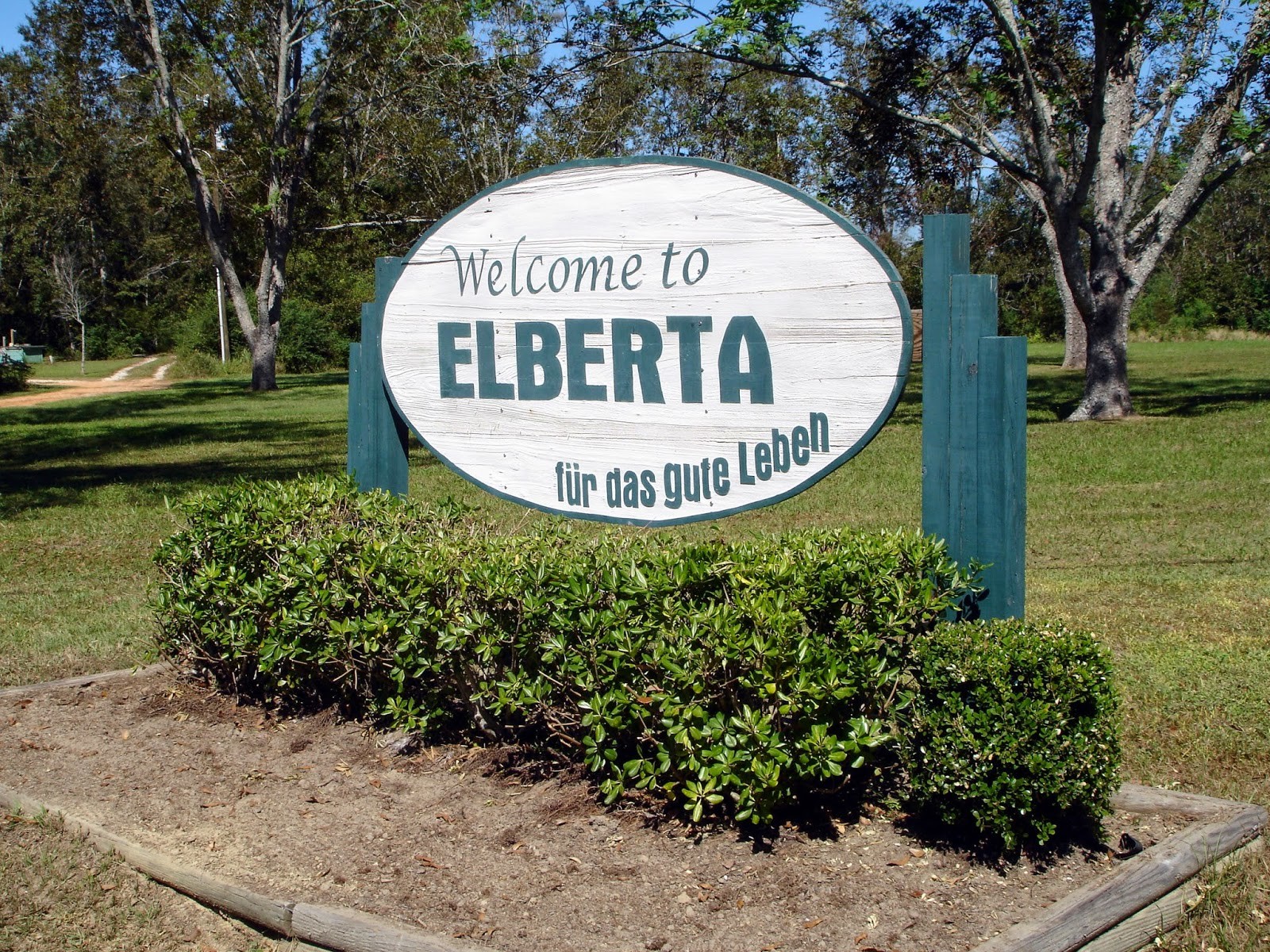
German immigrants shaped neighboring Elberta.
According to the Town of Elberta, the Baldwin County Colonization Company organized the settlement in 1903. The first settlers arrived the following year.
Many were German immigrants who had first settled in the Midwest before relocating to Baldwin County after reading advertisements promoting fertile soil and year-round farming.
The town embraces its German heritage through the phrase "fur das gute Leben," meaning "for the good life."
That heritage remains especially visible through the Elberta German Sausage Festival.
According to previous reporting by Gulf Coast Media, the festival began in 1978 as a fundraiser for the Elberta Volunteer Fire Department.
Its signature sausage traces back to Alfred "Pop" Stucki, whose secret recipe was preserved after his death. Gulf Coast Media reported that the recipe was entrusted exclusively to the festival and is now prepared by Farm Fresh Meats of Robertsdale.
What began with 100 pounds of sausage cooked on two backyard grills has grown into a biannual festival that attracts roughly 15,000 visitors while serving nearly 6,000 pounds of sausage each event.
Visitors interested in learning more about the area's heritage can visit the Baldwin County Heritage Museum in Elberta.
Not every immigrant settlement endured.
According to the Global Anabaptist Mennonite Encyclopedia Online, an Old Order Amish community formed east of Bay Minette beginning in 1906 after several men from Ohio and Indiana purchased recently logged land.
The settlement eventually grew to 18 families.
The Amish cleared fields, removed tree stumps and primarily raised potatoes. They sought larger farms than were common in Baldwin County at the time, but eventually discovered the soil was less productive than expected.
Hurricanes in 1916 and 1917 further devastated the settlement.
Most families left over the following years, and by 1924 the final settlers had departed.
The nearby Stockton Heritage Museum can give more information on the area's past as well as other places of interest in Bay Minette.
Even Baldwin County's celebrations have reflected its immigrant heritage.
Gabriel Gold-Vukson, director of the Fairhope Museum of History, shared an interesting tidbit.
"The first Dogwood Trail court costumes were designed to reflect the different nationalities that had settled in the county. The costumes included large skirts, sashes and hats. Nationalities represented included Italian, German, Swedish and Czech. It was a few years later that the dresses were redesigned to resemble a flower, in homage to the flowers of the dogwood tree, but kept the 'old world' skirts, sashes and hats."
As America celebrates its 250th anniversary, Baldwin County offers one of the state's clearest examples of how immigration shaped local history.
The descendants of Italians still farm and operate businesses. Greek Orthodox domes still rise over Malbis. Swedish settlers are remembered in Silverhill. German traditions continue through Elberta's famous sausage festival.
Their languages, customs and traditions blended with those of Native Americans and earlier Spanish, French and British influences to create the Baldwin County that exists today.
As the Baldwin County Department of Archives and History observed in "A Melting Pot of People, Places & Stories," the county's identity has been built by generations of people arriving from somewhere else, each adding another chapter to its story.
Sources for this article include the Baldwin County Department of Archives and History publication "A Melting Pot of People, Places & Stories"; statements from Felisha Anderson, director and county archivist for the Baldwin County Department of Archives and History; Gabriel Gold-Vukson, director of the Fairhope Museum of History; and Catherine P. King, Fairhope Single Tax Corporation Archives volunteer; and the documentary "A Noble Experiment: The Italian Colony in South Alabama" which premiered at the 2025 Fairhope Film Festival. Additional information came from historic markers in Daphne and Bay Minette and from the Town of Silverhill website and Town of Elberta website.
Also referenced were Gulf Coast Media reporting on the Elberta German Sausage Festival; the Farm Fresh Meats website; the Global Anabaptist Mennonite Encyclopedia Online website; and Malbis Memorial Church sources including Orthodox World website, OrthodoxWiki website, the Encyclopedia of Alabama website and Emmett Burnett's 2018 Alabama Living article.


