June brings increased temperatures and beach visitors by the droves, and it also marks the start of hurricane season.
This year, forecasters are predicting a below-normal season in the Atlantic …
This item is available in full to subscribers.
Please log in to continue |
June brings increased temperatures and beach visitors by the droves, and it also marks the start of hurricane season.
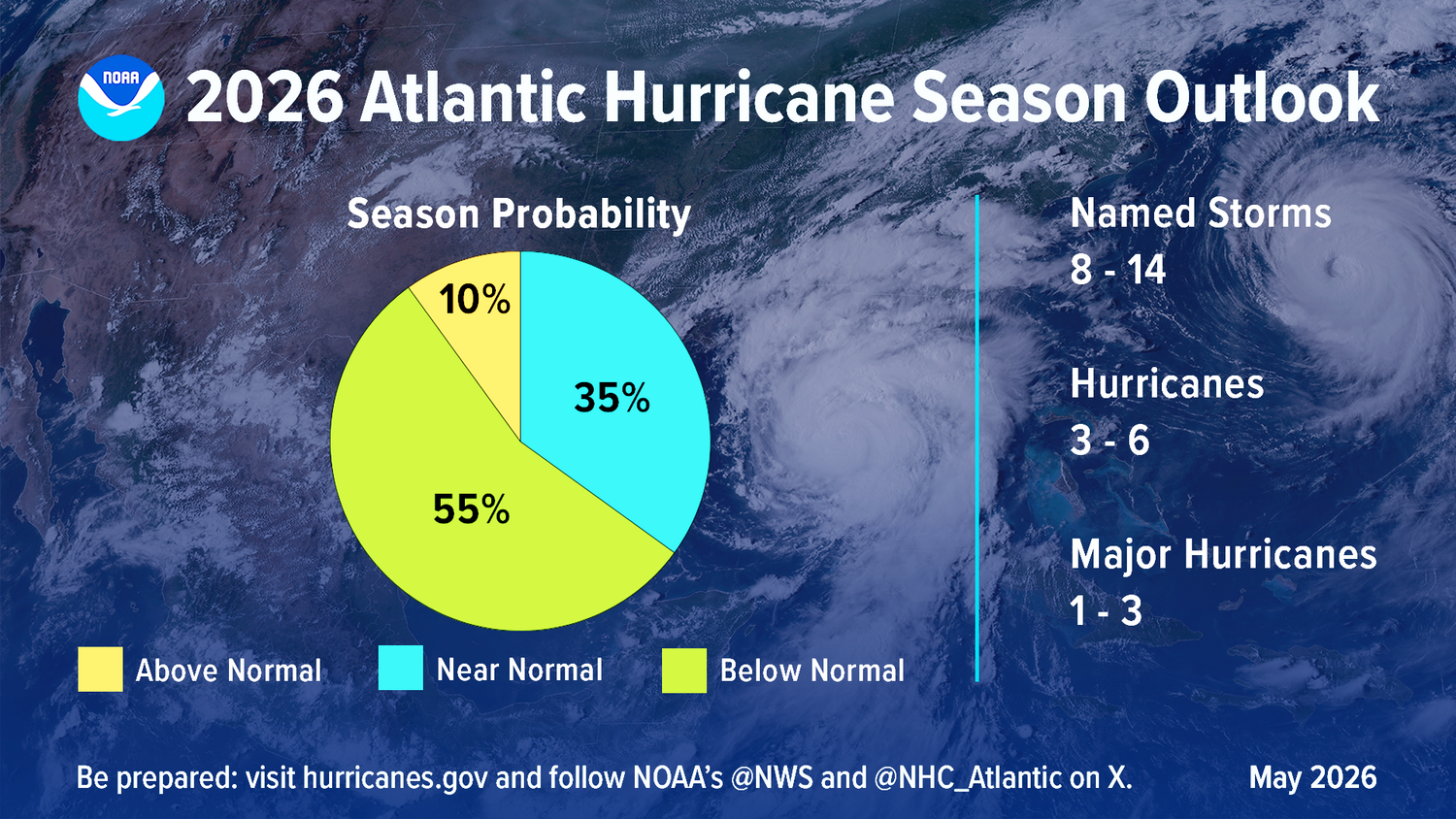
This year, forecasters are predicting a below-normal season in the Atlantic basin. Weather experts with NOAA's National Weather Service are forecasting between eight and 14 named storms (winds of 39 mph or higher). An average season has 14 named storms with seven hurricanes, including three major hurricanes.
Of those, three to six are forecast to become hurricanes (winds of 74 mph or higher), including one to three major hurricanes (category 3, 4 or 5 with winds of 111 mph or higher). NOAA has a 70% confidence in these ranges.
Colorado State University, the forecast study that is released earliest in the year, paints a similar outlook. CSU's Tropical Cyclones, Radar, Atmospheric Modeling, and Software Team within the Department of Atmospheric Science has predicted 13 named storms, of which they anticipate six to become hurricanes and two to become major.
Both groups cite the forecast of a robust El Niño as the primary factor for their outlooks.
El Niño is a recurring climate pattern that is characterized by warmer than normal water in the eastern and central pacific Pacific, which tends to increase upper-westerly winds across the Caribbean and into the tropical Atlantic. These winds results in conditions that are unfavorable for Atlantic hurricane formation and intensification.
"Currently, waters in the western tropical Atlantic are warmer than normal, while they are slightly cooler than normal in the eastern tropical and subtropical Atlantic. Overall, currently observed sea surface temperatures across the tropical and subtropical Atlantic present mixed signals for the upcoming hurricane season," the CSU team wrote in its outlook brief. "Warmer waters in the western Atlantic would favor above-normal activity, while cooler waters in the eastern tropical and subtropical Atlantic would favor below-normal activity. A warm Atlantic favors an above-average season, since a hurricane's fuel source is warm ocean water. Additionally, a warm Atlantic leads to lower atmospheric pressure and a more unstable atmosphere. Both conditions favor hurricane formation."
The team predicts that 2026 hurricane activity will be about 75% of the average season from 1991–2020. By comparison, 2025's hurricane activity was about 105% of the average season.
The most significant hurricane of the 2025 Atlantic hurricane season was Hurricane Melissa, which made landfall as a Category 5 hurricane in Jamaica, resulting in nearly $9 billion in damage and causing 95 fatalities across the Caribbean.
"So far, the 2026 hurricane season is exhibiting characteristics similar to the 2006, 2009, 2015 and 2023 seasons," said Phil Klotzbach, a senior research scientist in the Department of Atmospheric Science at CSU and lead author of the report.
The report also includes the following probability of major hurricanes making landfall in 2026:
• 32% for the entire U.S. coastline (average from 1880–2020 is 43%).
• 15% for the U.S. East Coast, including the Florida Peninsula (average from 1880–2020 is 21%).
• 20% for the Gulf Coast from the Florida panhandle westward to Brownsville, Texas (average from 1880–2020 is 27%).
"Although El Niño's impact in the Atlantic Basin can often suppress hurricane development, there is still uncertainty in how each season will unfold," said Ken Graham, NOAA's National Weather Service director. "That is why it's essential to review your hurricane preparedness plan now. It only takes one storm to make for a very bad season."
The 2025 Atlantic hurricane season ended up an above-normal season, according to CSU, with 13 named storms, five hurricanes and four major hurricanes.
All four major hurricanes reached at least Category 4 intensity, with three reaching Category 5 intensity (Erin, Humberto and Melissa). The season was benign for continental U.S. impacts, with only one tropical storm (Chantal) making landfall, costing around $500 million in damage. However, Hurricane Melissa caused devastation when it made landfall as a Category 5 hurricane in Jamaica.
"The above-normal active Atlantic hurricane season was likely driven in part by warmer than normal sea surface temperatures in the tropical Atlantic and Caribbean," a CSU report stated. "Despite these favorable conditions, the Atlantic underwent a mid-season lull (similar to 2024), with no named storms forming between Aug. 24-Sept. 16 – the first time that this had occurred since 1992.