
Sea turtle season got an early start with a twist in Alabama when a rare Kemp’s Ridley nest was found laid on April 30 and another Kemp’s Ridley came ashore to nest three days later.
…
This item is available in full to subscribers.
Please log in to continue |
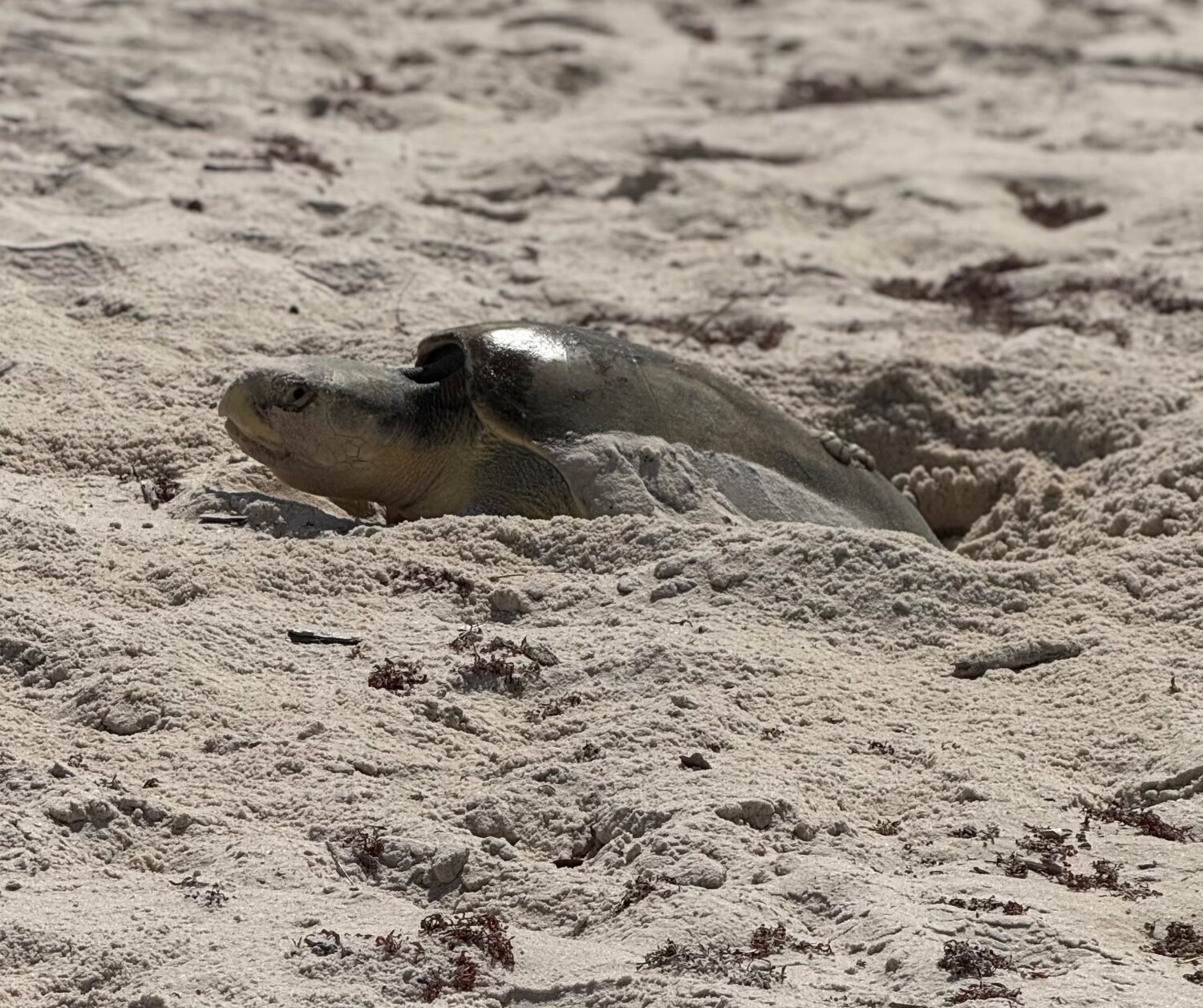


Sea turtle season got an early start with a twist in Alabama when a rare Kemp’s Ridley nest was found laid on April 30 and another Kemp’s Ridley came ashore to nest three days later.
So far, these are the only two nests recorded and protected by Share the Beach, a conservation program for Alabama’s sea turtle nests through the Alabama Coastal Foundation (ACF).
Share the Beach Director Rachael Holdsworth said both nests were spotted and reported by visitors to the sea turtle hotline at 866-SEATURTLE (or 866-732-8878). She requested the location of the nests remain anonymous as Share the Beach has “had issues with vandalism” to nests.
The first sighting, on April 30, was reported by the Hill family from Arkansas, who were at the beach on the last day of their vacation. The Hills' daughter, Evie, noticed the turtle first. Holdsworth said the Share the Beach team member who responded, Susan West, said she was “beaming with joy” while wearing a sea turtle necklace and t-shirt she bought as souvenirs earlier in the family’s trip. The Hills knew to call the sea turtle hotline number.
“They never expected to see a sea turtle on the beach,” Holdsworth said on behalf of the Hill family.
The second sea turtle sighting, on May 3, was spotted by Halee Pixey and Katie Harwell from Indiana. Holdsworth said they spotted the turtle crawling back to the water after laying her eggs. She said this crawl to the water “happened in less than a minute.”
“Luckily, (Harwell) had talked to Share the Beach volunteer, Nancy Forrester, earlier that morning and knew to call 866-SEATURTLE,” Holdsworth said.
Alabama sea turtle nesting season runs from May 1 to Oct. 31. Even with these dates, Holdsworth said the first nest is not normally seen until “a week or two into May.”
“Everyone was surprised to hear that there was a sea turtle laying her nest on the beach in the middle of the day the day before sea turtle nesting season began,” Holdsworth said.
Before there was confirmation, Holdsworth said the Share the Beach team had a feeling it would be a Kemp’s Ridley as that species is known to nest during the daytime, unlike the other two types of sea turtles commonly seen on the Alabama Gulf Coast.
The early nesting date may be different for Alabama's sea turtle season, but Kemp’s Ridley are known to nest earlier from April to July, Holdsworth said.
Before this year, there was “no record” of a sea turtle nest in Alabama before the official season start date.
A nest was spotted on May 1 in 2012, and false crawls — turtle tracks with no nest — were spotted as early as April 24 in 2017.
Holdsworth said Alabama sees inconsistent reports of Kemp’s Ridley each year. There will be “a handful of Kemp’s Ridley nests” one year and zero reports the next year.
Kemp’s Ridley sea turtles are critically endangered, according to the International Union for Conservation of Nature’s Red List of Threatened Species, and are federally protected, along with the other two turtles found in the area, under the Endangered Species Act of 1973, which means it is illegal to take, touch or even interfere with the protected sea turtles. A violation can result in up to $100,000 in fines.
“(Kemp’s Ridley) are especially rare for our area, and they lay most of their nests on the east coast of Mexico,” Holdsworth said. “… In Alabama, if we get a Kemp’s Ridley nest, we usually have one sea turtle nest at a time. However, Kemp’s Ridley sea turtles are known for an arribada event, where the adult females gather offshore in large groups until something cues them to all swim to shore and lay their nests.”
Holdsworth said these first two sightings are not significant indicators of what the “overall nesting season” will look like, especially since Kemp’s Ridley are known for nesting earlier in the season.
“We are feeling optimistic for a busy nesting season after a slow season last year, but it is too early to tell,” Holdsworth said. “… We are all excited though and looking forward to the months ahead.”
As previously reported by GCM, in 2023 there were a total of 143 nests found, out of which four were confirmed to be Kemp's Ridley nests. Out of 78 total nests found in 2024, one nest was confirmed to belong to Kemp’s Ridley with three nests suspected to have been Kemp's Ridley.
Holdsworth recommended for residents or visitors walking along the beach to keep an eye out for nesting turtle activity and report anything related, such as turtle tracks or possible nests.
While Kemp’s Ridley turtles nest during the day, the other sea turtles commonly seen in the Alabama Gulf Coast nest during the night. Green sea turtles are about as rare as Kemp’s Ridley, and Loggerheads are the most common sea turtles found nesting in Alabama.
Some tips from Holdsworth to remember when a sea turtle is spotted is to give the nesting turtle at least 30 feet of space so you don’t startle her from her job, to stay calm and quiet as you wait for Share the Beach volunteers, and no white-light flashlights or flash photography near the turtle. She encouraged the use of a red or amber light to be used on the beach at night if a light is necessary.


