FAIRHOPE, Ala. — State and local officials announced Wednesday construction plans for a $14 million Science and Allied Health studies building on the Faulkner State Community College Fairhope campus. The 52,000-square-foot structure will be built …
This item is available in full to subscribers.
Please log in to continue |
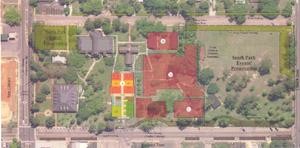
FAIRHOPE, Ala. — State and local officials announced Wednesday construction plans for a $14 million Science and Allied Health studies building on the Faulkner State Community College Fairhope campus. The 52,000-square-foot structure will be built along Bancroft Street, and is part of a larger blueprint that will provide the school with the space to expand existing programs and create new programs that will help meet student and community needs.
The plan calls for work on the three-story building to begin as early as this summer and be completed sometime in the fall of 2009. It will house chemistry, physics, biology and microbiology classrooms and labs; eight allied health classrooms and labs; 17 science/allied health classrooms; 11 faculty offices; and a new student center.
Funding came from a number of sources, including private donations, bond issues and state and local government. Alabama Community College System Chancellor Bradley Byrne also chipped in $1 million from his discretionary fund.
FSCC President Gary Branch said the new building will be a shot in the arm for the nursing programs at Faulkner.
“Total enrollment is up this year by 7 percent,” he said. “There are no vacant classrooms — not an empty office. We’ve got more nursing applicants than we can handle. That’s what’s so exciting about what’s going to happen.”
Faulkner currently offers a two-year associate degree in nursing, an associate degree in applied science, a one-year licensed practical nurse certificate and several other health-related degrees. The nursing programs are accredited by the National League of Nursing Accrediting Commission.
Branch said FSCC nursing students have maintained a 100 percent pass rate on the National Council Licensure Examination since the programs were introduced at the two-year school — something never before done in Alabama. Now they just need the room to learn, he added.
“We’re excited about this (building) coming to Fairhope,” said Doug Garner, Thomas Hospital vice president. “Health care is all about responding with the best you have. Faulkner responded with operating room scrub tech training and nursing. The commitment at Faulkner paved the way for the future that stands before us.”
With more people moving to the coast, even more health-related job openings are sure to follow.
Byrne said, “We have a significant need for allied health program students. There’s a substantial need for more nurses. That’s not a static need. It’s growing all the time.”
Owen Bailey, executive vice president for community and governmental affairs at Infirmary Health System, agrees. He said, “I think it’s a very exciting announcement, and it comes at a great time. One of the issues is there’s an aging population and a lot of economic growth in our region. It’s getting tougher and tougher to find not only qualified employees to plug in, but to plug them in when needed.”
Bailey noted there is currently a lack of trained personnel in a number of health care specialties, including telemetry, medsurge, respiratory technology, pharmacy and medical assistance, and it is believed that Faulkner, working in partnership with the University of South Alabama College of Nursing and area hospitals, will help fill those positions.
“Those are the shortage areas,” Bailey said. “I think it’s important that we at hospitals don’t just sit and look to the educational community. We must partner with them. Hospitals work together in providing clinical instruction.”
IHS operates not only Thomas Hospital, but also Thomas Medical Center and Infirmary Eastern Shore in Daphne; North Baldwin Infirmary in Bay Minette; Mobile Infirmary Medical Center and Infirmary West in Mobile.
Bailey said, “The team at Faulkner State does a great job with the students. The students are very well prepared and the college does a very good job.”
Also revealed this week were other elements of the campus master plan that include a 32,000-square-foot combined Performing Arts Center/Production Technology building that will dominate the center of the campus. It will house live performances along with classes in cinematography, 3-D computer animation, screenwriting and other crafts needed to attract the film industry to the area.
Byrne said he is working with the state Legislature to offer solid incentives that might lure Hollywood to the Alabama coast.
Preparing young men and women to meet the needs of television and motion picture producers is an important part of gaining a larger share of their business, he added, saying, “You have to have the people with the technical capability to make the movies. You have to have a trained work force just as you do in the steel making and shipbuilding industries.”
He pointed out that several California two-year institutions already have film schools.
Many movies and television programs have been filmed in Baldwin and Mobile counties over the years, including “Under Siege,” War and Remembrance,” “Close Encounters of the Third Kind,” “Movin’ On,” “Back Roads,” “Felony,” “Friday the 13th Part VII,” “Rapid Fire,” “Mission of the Shark,” “The Insider,” “Mi Amigo,” “American Leather” and “Love Liza.”
The upstart film program will temporarily use the third floor of the Science and Allied Health building, while science classes will settle on the first floor and nursing instruction on the second.
The film school will move to its permanent home when it is completed. No timetable was announced for construction of that building or two others (18,200 and 18,000 square feet) that are penciled in for possible future growth.
Mac Walcott, a partner in Walcott Adams Verneuille, the firm that designed the new building and master plan, said the future look of the campus would likely please the late Dorothy “Mama Dot” Cain.
Even in her later years, Cain kept an eye on the former campus of the Marietta Johnson School of Organic Education, and supported the idea of preserving its green space.
“Good stewardship comes with great advocacy,” Walcott said. “This campus is like an arboretum.”
Although the new structure will have an impact on some of the existing green space, he said 4.3 acres will be preserved under the master plan.
Two sections of the campus, the south end adjacent to Morphy Avenue (168,200 square feet) and the northeast corner on School Street (17,000 square feet), will remain undisturbed.
Angled parking could one day replace the parallel parking spaces on Fairhope Avenue in front of the campus, according to the plan, and three rows of permeable angled parking for peak times and special events might border the south side of the campus.
The Science and Allied Health building will be at least the fourth to occupy the site. Among them were the Faulkner gym and recreation center known as “The Hangout,” as well a hall honoring the late Lydia J. Newcomb Comings that was part of the Organic School.
Branch praised Dr. John Borom, director of the FSCC campus in Fairhope, for his hard work in getting to this point. He said he remembers Borom having a desk in the basement of the old Baptist church, and the curriculum there limited to a few night classes.
“It’s an honor to me to live in my hometown and work at a college doing what I love to do, Borom said. “We’re stewards of this educational facility, and we want to use it to help give people a better life.”
Byrne added, “The vision for building on this campus and expanding these programs was an idea whose time had come.”