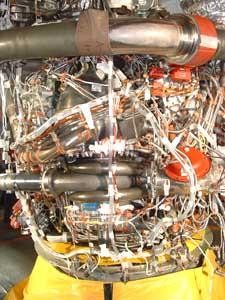
BAY ST. LOUIS, Miss. — Punctuated by a rumble and roar that could nearly shake the fillings out of one’s teeth, NASA conducted the last planned test of a space shuttle main engine on Wednesday (July 29). It marked the end of a successful run …
This item is available in full to subscribers.
Please log in to continue |
BAY ST. LOUIS, Miss. — Punctuated by a rumble and roar that could nearly shake the fillings out of one’s teeth, NASA conducted the last planned test of a space shuttle main engine on Wednesday (July 29). It marked the end of a successful run that began when the first SSME was tested at the John C. Stennis Space Center on June 27, 1975.
More than 150 Stennis employees, NASA officials and media representatives gathered near the A-2 Test Stand on what turned out to be a sweltering coastal Mississippi afternoon to witness the historic event, a bittersweet moment for many there as the Space Shuttle Program prepares to wind down next year.
“It’s a mixed emotion day,” said Jim Paulsen, vice president and program manager for the Space Shuttle Main Engine Program at NASA contractor Pratt & Whitney Rocketdyne. “These tests have been a very critical element in making SSME successful.”
Paulsen went on to say, “We’ve delivered more than 50 engines, and each had to undergo the rigorous testing at Stennis. It is one of the most reliable engines in use in the space program today.”
The engines have been certified for use on almost 130 shuttle missions, and can be used to power more than a dozen flights before being retested.
The 520-second tests were designed to simulate the total run time and various altitudes where the shuttle is positioned as it breaks free of Earth’s atmosphere, and is propelled into space.
Although not much larger than an automobile engine, the Rocketdyne SSME high-pressure fuel turbopump generates 100 horsepower for each pound of its weight, while a car engine typically generates only about 0.5 horsepower per pound.
According to the company, if water instead of fuel were pumped by three of the engines (the number mounted in each shuttle), an average family sized swimming pool could be drained in just 25 seconds.
Jerry Cook, manager of the Space Shuttle Main Engine Project Office at NASA’s Marshall Space Flight Center in Huntsville, said, “The heart and soul of the engine comes through Stennis, and no matter what engine we choose in the future, that engine will continue to come through Stennis.”
NASA officials point out that no mission has failed due to the malfunction of one of these Stennis-tested systems.
“The excellent flight record of the space shuttle main engine can be largely attributed to the test team at Stennis Space Center,” said Ronnie Rigney, acting space shuttle main engine test project manager at the NASA facility. “We have performed over 2,000 tests, totaling more than one million seconds of accumulated hot-fire time in support of the development, certification, acceptance and anomaly resolution for the space shuttle main engine.”
In the 34 years since testing on the engines began, some 300 million gallons of propellant (liquid oxygen and liquid hydrogen) have been burned, Paulsen added.
NASA designated Stennis in 1971 as the site for SSME testing. More than 500 tests were conducted on the engine and related components prior to the first shuttle flight. Stennis engineers also test-fired the three-engine cluster arrangement.
All three Stennis test stands were once involved in shuttle engine testing. But it became limited to only the A-2 Test Stand as engineers began to prepare the A-1 for testing the J-2X engine currently in development. That propulsion system will help power the Ares I and Ares V rockets that will take humans back to the moon and possibly beyond as part of NASA’s Constellation Program.
“It would be difficult to overstate the role Stennis has played in our nation’s space program for the last 34 years,” said Gene Goldman, Stennis director. “Its workers have created an unparalleled legacy of engine testing excellence.”
Stennis has also had a huge economic impact since the space center opened in the mid-’60s. Last year alone, the center had an estimated $840 million global impact, according to a study released in February by Dr. Charles A. Campbell, a Mississippi State University professor of economics.
Around $691 million of that directly or indirectly boosts the economy within a 50-mile radius of Stennis. That translates into an estimated 31,778 jobs across the region.
The report also indicates that 29 percent of those employed at Stennis live in Pearl River County, Miss., while 18 percent live nearby in both Harrison and Hancock counties. Around 5 percent live in other Mississippi counties; 24 percent are residents of St. Tammany Parish, La.; 4 percent live elsewhere in Louisiana; and 2 percent live in other states and make a rather lengthy commute, including at least one man who lives in Baldwin County.
“Stennis Space Center is truly unique in that propulsion test operations expertise has been passed from generation to generation through the Apollo and Shuttle programs since the mid-1960s, making this workforce one of the most knowledgeable in its field,” Rigney explained. “This last test of the space shuttle main engine represents great accomplishments for this team, as well as new opportunities and challenges to transition to a new era in the nation’s space program.”